AIAG-VDA Process FMEA Upgrade
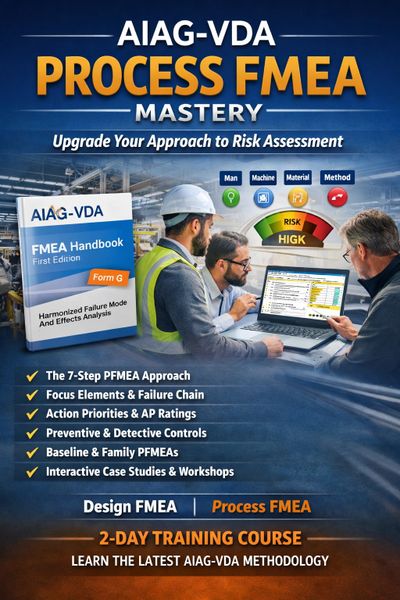
This two-day course is designed to teach participants the new approach of the AIAG-VDA FMEA First Edition, including “Form G”, required by FCA. It is essential that participants have experience creating and using existing FMEA tools, as the fundamentals of Process FMEA are not discussed.
This FMEA upgrade course is offered for either Design FMEA or Process FMEA. Although the format of the chart is the same, they are very different analytical methods and are only properly addressed as two separate training courses.
By starting with a thorough understanding of all the process steps and their requirements, Process Failure Modes and Effects Analysis (PFMEA) is a very powerful tool to help teams determine potential failure modes for a process design before they occur. Once these failure modes have been determined, control methods can be put into place to prevent the failure or prevent its escape. This session is based on the AIAG-VDA FMEA Manual (First Edition).
The following are highlights of the Process FMEA topics discussed:
• The seven phases of PFMEA
• Focus Elements
• The Failure Chain
• Action Priorities (AP) to Risk Priority Numbers (RPN)
• Simplified approach by using baseline or family PFMEAs as modules to build new programs
• Increased emphasis on the effect of failure on levels of customers
• Considering potential failure causes for each of Man, Material, Machine, Method, Environment.
• Preventive controls vs. Detective controls
• Completing the PFMEA form
Classroom lecture is combined with interactive workshops created from the organization’s own process FMEAs. This will ensure that participants understand how to upgrade their existing Process FMEAs to the new AIAG-VDA format and create new Process FMEAs for future automotive programs in a way that increases their value for the organization and its customers.
Upgrade to AIAG APQP 3rd Edition and AIAG Control Plan 1st Edition
This two day course introduces participants to the new requirements of the AIAG APQP Third Edition and the AIAG Control Plan First Edition. No advanced knowledge of APQP or Control Plans is required, as the session includes a full review of current methods and best practices.
Advanced Product Quality Planning (APQP) provides a structured approach to ensure that new product launches include the right quality controls, enabling early detection of risks and preventing defects before they reach the customer.
New APQP content includes:
• Updated APQP checklists
• Expanded guidance for existing concepts
• Greater emphasis on sourcing and high risk suppliers
• Increased focus on capacity planning
• Enhanced expectations for change management during APQP
The course also reinforces foundational APQP principles, including the five phases and the phase gate approach used to guide successful product launches.
The Control Plan is the central document that defines all product and process controls required to ensure defect free output. While the overall format remains familiar, the new edition introduces several important concepts:
• Safe Launch Control Plans
• Required inclusion of Pass Through Characteristics (per CQI 19)
• Mandatory error proofing methods and verification
• Clear expectations for rework, repair, and abnormal conditions
• Encouraged use of the Special Characteristics Worksheet
• Expanded guidance on Family Control Plans

IATF 16949:2016 Implementation
This course, offered in one or two day formats, teaches participants the requirements of the IATF 16949:2016 standard. The content applies equally to automotive parts manufacturers at all tiers, whether their customers are North American, European, or Japanese. Emphasis is placed on the process orientation of the standard and its integration with ISO 9001:2015.
The 2016 revision represents the most significant change to the automotive industry in over a decade. The structure of the document has been completely reorganized, and several key baseline requirements have evolved to reflect modern quality management practices.
Key topics include:
• Understanding the organization and its context
• Identifying the needs and expectations of interested parties
• Actions to address risks and opportunities
• Determining and maintaining organizational knowledge
• The role of management and strategic direction in IATF 16949
• The evolution of the global automotive quality standard
• The process approach to quality management
• Applying requirements in the context of your organization
• Employee competency, motivation, and engagement
• Customer specific requirements
To fully understand the leadership requirements and properly define the context of the organization, it is strongly recommended that members of senior management attend at least the first half of the session. The most relevant participants include:
Executive Management, Sales and Marketing, Engineering, Human Resources, Materials Management, Operations, Quality Assurance, and Internal Auditors.
Classroom instruction is reinforced through interactive workshops that help participants apply the principles of IATF 16949. These exercises emphasize the process approach, risk based thinking, organizational knowledge, and the integration of customer requirements into daily operations.
Internal Auditor with Core Tools IATF 16949:2016
This three day course is designed to meet full compliance with the customer specific requirements of Stellantis, General Motors, and Ford Motor Company. It provides participants with the knowledge and practical skills to assess the effectiveness of their organization’s Quality Management System in alignment with the IATF 16949:2016 standard.
No prior certification in IATF 16949 is required, though familiarity with the standard is beneficial. The program combines classroom instruction with hands on auditing experience to ensure participants can confidently evaluate process performance and compliance.
Course Overview
Participants will learn the fundamentals of internal auditing and the application of the Core Tools that support automotive quality systems. The training emphasizes maintaining a “big picture” perspective understanding how each process contributes to overall organizational performance and risk management.
Audit Phases Covered:
• Planning
• Preparation
• Performing the Audit
• Reporting and Verification
The foundation of IATF 16949 is that quality management systems must be built around the organization’s core processes. This course teaches participants how to use internal audits to test process effectiveness, manage risk, and drive continuous improvement.
Core Tools Integration:
• Statistical Process Control (SPC)
• Advanced Product Quality Planning (APQP)
• Measurement Systems Analysis (MSA)
• Failure Modes and Effects Analysis (FMEA)
• Production Part Approval Process (PPAP)
Course Structure:
Day 1: Introduction to IATF 16949 and customer specific requirements, followed by process approach training.
Day 2: Deep dive into Core Tools and their application in auditing.
Day 3: Audit preparation, execution, and reporting, including a live audit simulation conducted in accordance with ISO 19011.
Each small group conducts a real internal audit of their organization’s processes, prepares a report, and participates in a closing meeting with senior management. This practical experience ensures participants leave with the confidence and competence to perform effective internal audits that strengthen their organization’s quality system.
Understanding ISO 14001:2015
This one day course introduces participants to the fundamentals of the ISO 14001:2015 Environmental Management System (EMS). By the end of the session, participants will understand how to identify the environmental aspects and impacts of their organization and set measurable objectives to reduce those impacts.
This program can also be combined with the two day Internal Auditor training to qualify your EMS internal audit team.
Key Learning Elements:
• Determining environmental aspects, impacts, and objectives
• Strategies for assessing and prioritizing environmental risks
• Understanding the clauses and structure of ISO 14001:2015
• Defining organizational context and interested parties
• Leadership accountability and commitment
• Actions to address risks and opportunities
• Applying the life cycle perspective
Classroom instruction is supported by interactive discussion to ensure participants understand how ISO 14001 can strengthen business performance and demonstrate environmental stewardship.
The session concludes with a hands on workshop where small groups identify the key environmental aspects and impacts within their organization. This practical exercise reinforces the learning and ensures participants can confidently apply the principles of the standard.
For automotive organizations, an optional workshop is available to review the APQP process through a life cycle lens and propose improvements that better integrate environmental considerations into product launch activities.

Implementing the ISO 45001:2018 Occupational Health & Safety Standard
This one day course introduces participants to the fundamentals of the ISO 14001:2015 Environmental Management System (EMS). By the end of the session, participants will understand how to identify the environmental aspects and impacts of their organization and set measurable objectives to reduce those impacts.
This program can also be combined with the two day Internal Auditor training to qualify your EMS internal audit team.
Key Learning Elements:
• Determining environmental aspects, impacts, and objectives
• Strategies for assessing and prioritizing environmental risks
• Understanding the clauses and structure of ISO 14001:2015
• Defining organizational context and interested parties
• Leadership accountability and commitment
• Actions to address risks and opportunities
• Applying the life cycle perspective
Classroom instruction is supported by interactive discussion to ensure participants understand how ISO 14001 can strengthen business performance and demonstrate environmental stewardship.
The session concludes with a hands on workshop where small groups identify the key environmental aspects and impacts within their organization. This practical exercise reinforces the learning and ensures participants can confidently apply the principles of the standard.
For automotive organizations, an optional workshop is available to review the APQP process through a life cycle lens and propose improvements that better integrate environmental considerations into product launch activities.
ISO 9001:2015 – Metrics and Management Review
This one day course demonstrates best practices for defining process metrics and conducting effective management reviews within a Quality Management System.
Rather than focusing on organizational strategy or long term goal setting, this session emphasizes the fundamentals of process management. Participants learn how to establish meaningful targets, track progress, and use data to guide improvement. The course concludes with a clear framework for Management Review within the context of ISO 9001:2015.
Key learning topics include:
• The process approach to quality management
• Selecting and defining process metrics
• Understanding key performance indicators
• Making data driven decisions
• Cost of poor quality
• Balanced Scorecard
• Management Review
• Feedback for improvement
ISO 9001:2015 is built on the principle that quality management systems should be structured around the organization’s core processes. This course helps participants define criteria for evaluating process effectiveness and integrate those results into Management Review.
Many organizations struggle to distinguish between local process metrics and the higher level indicators used to manage the business. This session clarifies the role of process owners and demonstrates which metrics they need to manage daily performance and which indicators should be consolidated at the enterprise level. The Balanced Scorecard is introduced as a best practice for presenting these results in a clear and meaningful way.
Classroom instruction is supported with examples and hands on workshops so participants can apply appropriate metrics to their processes and conduct effective management reviews within their organizations.
Root Cause Analysis and Corrective Action
This two day course teaches participants how to perform effective problem solving by identifying and eliminating the true root cause of issues. The content incorporates concepts from the AIAG CQI 20 second edition and emphasizes disciplined, fact based thinking.
Root Cause Analysis is essential for understanding why problems occur and for taking permanent action to ensure they do not return.
The DOT STAR problem solving method is used as the central framework:
• Define the problem
• Observe the process
• Think of the most likely causes
• Select a cause for investigation
• Test and prove the theory
• Act on the results
• Review and revise the process
Additional tools are introduced to strengthen understanding and application:
8 Disciplines (8D) – a structured sequence for effective problem solving, from defining the problem through verification and sustaining improvements
Is and Is Not – a strategy for properly defining the problem
Five-Why – a technique for drilling down to the true root cause
A discussion of statistical tools includes the classic Seven Tools of Quality:
• Pareto charts
• Check sheets
• Control charts
• Process flow diagrams
• Fishbone diagrams
• Scatter diagrams
Classroom instruction is supported with examples from the organization to help participants write accurate problem statements and consistently identify the correct root cause. Emphasis is placed on using the DOT STAR method as a standardized, fact based approach to problem solving, supported by the statistical methods introduced throughout the course.

Failure Modes and Effects Analysis (FMEA)
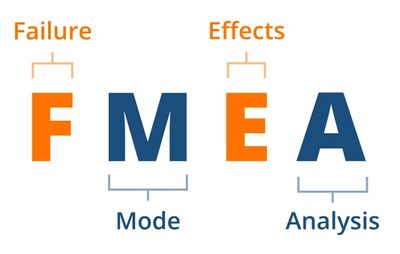
This two-day course is designed to teach participants the basics of the AIAG Failure Modes and Effects Analysis (FMEA) methodology. It fully addresses the AIAG FMEA Fourth Edition.
This FMEA course is offered for either Product Design FMEA or Manufacturing Process FMEA. Although the format of the chart is the same, they are fundamentally different analytical methods and are only properly addressed as two separate training courses.
Whether your organization is registered to IATF 16949, or ISO 9001, the FMEA is likely the most powerful tool that Process Engineers and Managers have at their disposal. Training in the FMEA methodology can assist all members of the organization to anticipate failure and prevent a problem before it occurs.
Emphasis is placed on Thinking Risk. Whether the risk is to product, process, operator, or even market share, examples encourage a risk-based approach to decision making.
Topics Covered
• Why FMEAs are performed, and their benefits
• Introduction to FMEA
• Tying Design and Manufacturing Process Failure Modes to Functions
• Guidance on Ranking Tables for Severity, Occurrence, Detection
• Consistent application of Risk Priority Numbers
• Completion of the FMEA Chart
• The importance of Recommended Actions and Follow-up
Classroom lecture is combined with illustrative examples and two hands-on work shops to ensure that participants are able to apply the abstract concepts of the FMEA to their every-day work.
Advanced Product Quality Planning (APQP)
This three-day course is designed to teach participants the basics of the AIAG Advanced Product Quality Planning (APQP) process. Detailed discussion of FMEA and Control Plans will ensure that participants are able to contribute effectively in a cross-functional APQP team.
The Five Phases of APQP
• Plan and Define the Program
• Product Design and Development
• Process Design and Development
• Product and Process Validation
• Feedback, Assessment, and Corrective Action
The Four PPAP Outputs
• The Team Feasibility Commitment
• DFMEA and PFMEA
• Control Plans
• Process Flow Diagrams
Emphasis is placed on training participants in their organization’s own APQP procedure. Wherever possible, the training session is used to begin the APQP process for an actual product launch.
The kick-off meeting can be conducted, and the Process Flow Diagram, PFMEA and Control Plan can be substantially completed.
Another key learning objective is to ensure that participants are taught to think from a “risk” perspective, to ensure that all discussion and decision making is solidly focused on risk reduction.
Classroom lecture is combined with interactive workshops created from the organization’s own procedures to ensure that participants have the ability to fully participate on an APQP team, using all of the tools and techniques at their disposal.